
Local Anaesthesia for Dental Boards: Techniques, Landmarks and Complications
Local anaesthesia is tested on every dental board exam because it combines anatomy, pharmacology and patient safety in one procedure you perform daily. This guide covers the techniques, the landmarks behind them, why blocks fail, dose calculations and the complications examiners ask about most.
By the Socket Science editorial team · Reviewed by a qualified dentist
Independent resource. DentistUP is not affiliated with or endorsed by any examination authority. Always check the official exam body for current format, dates and eligibility. Educational content, not patient-specific clinical advice.
The anatomy behind every technique
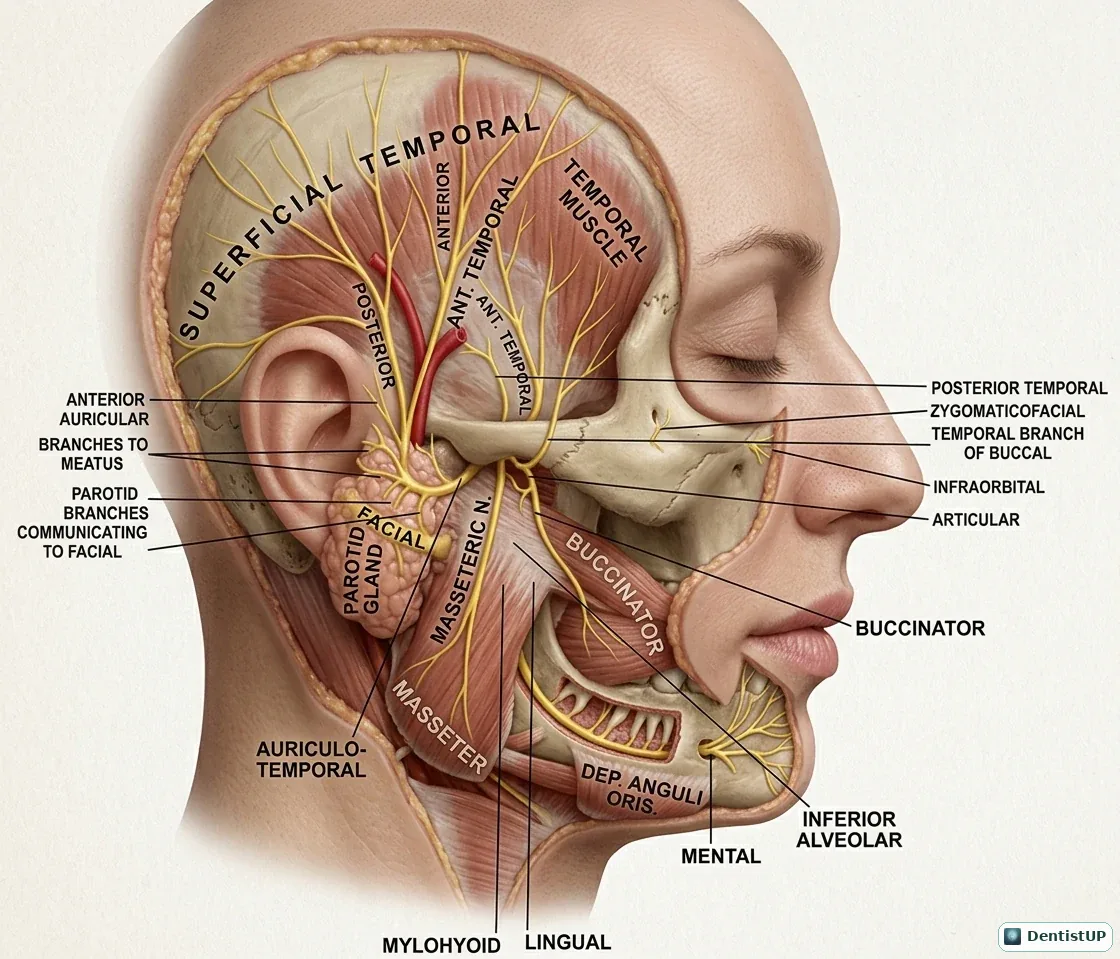
Almost every local anaesthesia question can be answered from the course of the trigeminal nerve. The maxillary division (V2) supplies the maxillary teeth through the posterior, middle and anterior superior alveolar nerves, and the palate through the greater palatine and nasopalatine nerves. The mandibular division (V3) supplies the mandibular teeth through the inferior alveolar nerve, the tongue and lingual gingiva through the lingual nerve, and the buccal gingiva of the molars through the long buccal nerve.
Inferior alveolar nerve block (IANB)
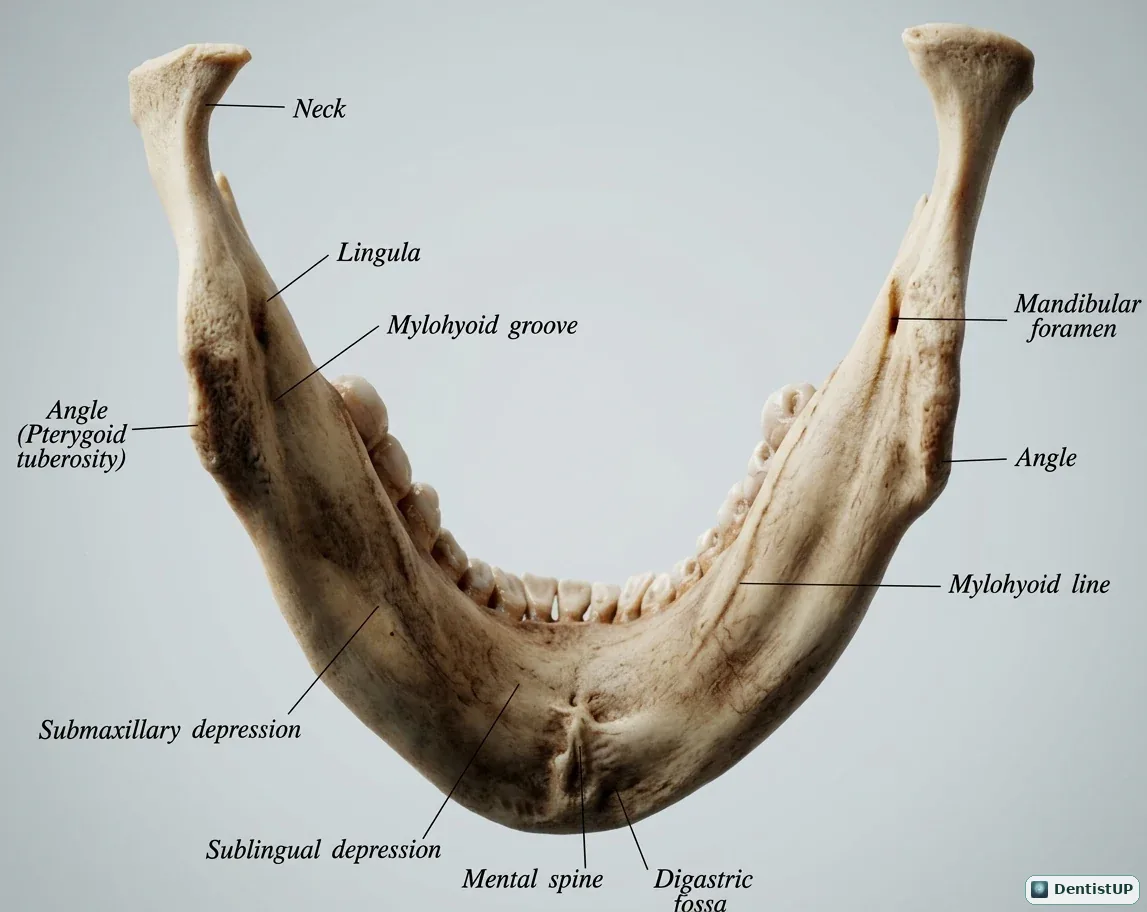
The target is the inferior alveolar nerve just before it enters the mandibular foramen, which is partly covered by the lingula on the medial surface of the ramus. The key intraoral landmarks are the coronoid notch, felt with the thumb on the anterior border of the ramus, and the pterygomandibular raphe. The needle approaches from the premolars of the opposite side, enters lateral to the raphe at roughly the level of the thumb in the coronoid notch, and advances until it gently contacts bone. Aspirate before depositing.
A successful IANB anaesthetises the mandibular teeth on that side to the midline, the lower lip and chin through the mental nerve, and usually the tongue and lingual gingiva because the lingual nerve lies nearby. It does not reliably anaesthetise the buccal gingiva of the molars, which is why a separate long buccal injection is added for extractions.
Why the IANB fails
- Technique: deposition too low (below the foramen) or too anterior is the most common cause.
- Anatomy: a high foramen, a wide ramus, or a bifid mandibular canal.
- Accessory innervation: the mylohyoid nerve, cross-innervation of the incisors from the other side, or the long buccal nerve for buccal soft tissue.
- Inflammation: inflamed tissue has a lower pH, so less of the anaesthetic exists in the uncharged base form that crosses nerve membranes. This is why a "hot" tooth with irreversible pulpitis is hard to numb.
Alternatives and supplements
- Gow-Gates block: targets the neck of the condyle with the mouth wide open, anaesthetising most of V3 with a higher target.
- Vazirani-Akinosi (closed-mouth) block: useful when trismus prevents wide opening.
- Buccal infiltration with articaine: often used as a supplement to an IANB for mandibular molars.
- Intraligamentary and intraosseous injections: localised supplements for a single tooth.
Maxillary techniques
Maxillary bone is thinner and more porous than mandibular bone, so buccal infiltration usually anaesthetises maxillary teeth well. Blocks are used for wider areas:
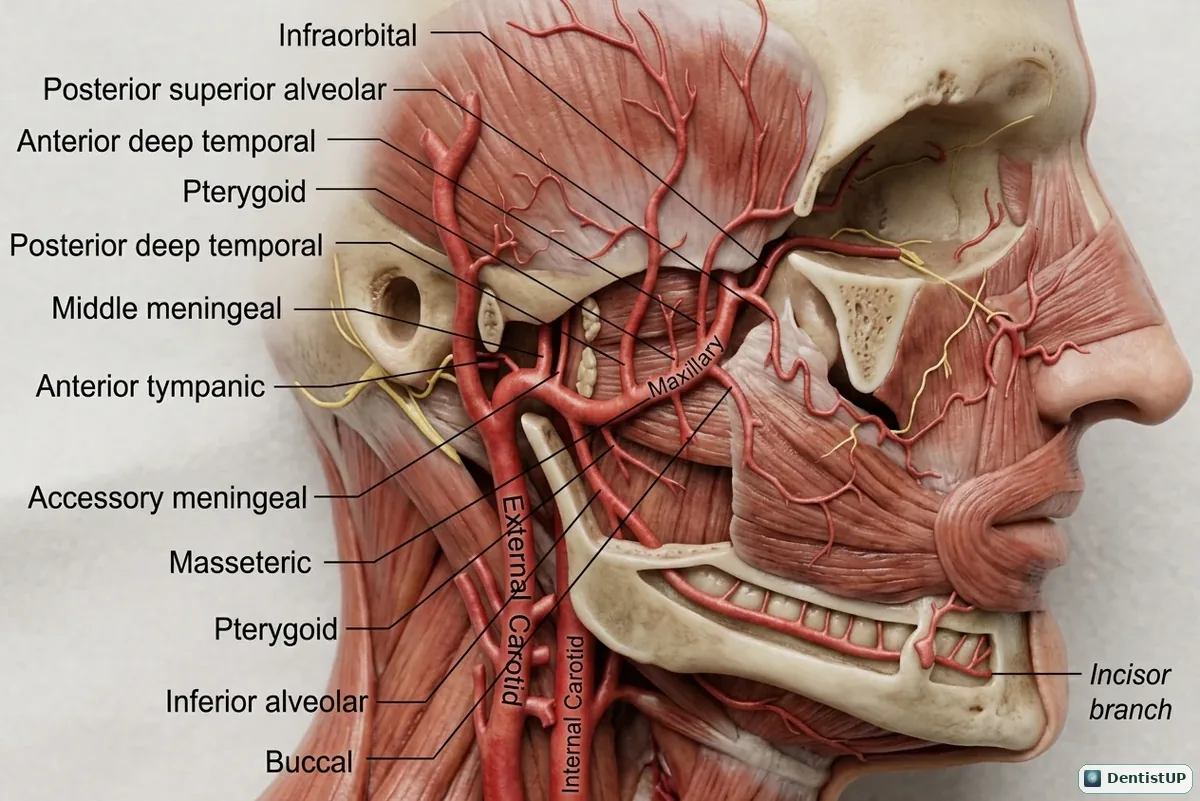
- Posterior superior alveolar (PSA) block: inserted at the height of the mucobuccal fold above the second molar, directed upward, inward and backward. It anaesthetises the maxillary molars, although the mesiobuccal root of the first molar may be supplied by the middle superior alveolar nerve. Over-insertion risks a haematoma from the pterygoid venous plexus.
- Infraorbital (anterior superior alveolar) block: targets the infraorbital foramen to anaesthetise the incisors, canine and, in many patients, premolars, plus the lower eyelid, side of the nose and upper lip.
- Greater palatine block: at the greater palatine foramen, usually opposite the second or third molar, for the posterior hard palate.
- Nasopalatine block: at the incisive papilla for the anterior palate, one of the most uncomfortable injections, so slow deposition helps.
Pharmacology in brief
Local anaesthetics are weak bases that block voltage-gated sodium channels. Amides (lidocaine, articaine, mepivacaine, prilocaine, bupivacaine) are metabolised mainly in the liver; articaine is also rapidly broken down in plasma because of its ester group. Esters are metabolised by plasma cholinesterases and are more often associated with allergy.
Vasoconstrictors such as epinephrine slow systemic absorption, which prolongs anaesthesia, improves haemostasis and lowers peak plasma levels. For patients with significant cardiovascular disease, many references suggest limiting epinephrine to about 0.04 mg per appointment, roughly two 1.8 mL cartridges of 1:100,000.
Dose calculations
Exams often give a weight and ask for a maximum dose or number of cartridges. Convert concentration first: a percentage is grams per 100 mL, so 2% = 20 mg/mL and 4% = 40 mg/mL. Reference maximums differ between countries, manufacturers and textbooks, so use the values your exam expects. Commonly cited figures include:
| Agent | Commonly cited maximum | Concentration |
|---|---|---|
| Lidocaine with epinephrine | 7 mg/kg (max 500 mg) in many references; 4.4 mg/kg (max 300 mg) in some | 2% = 20 mg/mL |
| Articaine with epinephrine | 7 mg/kg | 4% = 40 mg/mL |
| Mepivacaine | 6.6 mg/kg (max 400 mg) | 3% plain = 30 mg/mL; 2% = 20 mg/mL |
| Prilocaine | 8 mg/kg (max 600 mg) | 4% = 40 mg/mL; 3% = 30 mg/mL |
| Bupivacaine | 1.3 mg/kg (max 90 mg) | 0.5% = 5 mg/mL |
Worked example: a 20 kg child, 2% lidocaine with 1:100,000 epinephrine in 1.8 mL cartridges, using 4.4 mg/kg. Maximum dose = 20 × 4.4 = 88 mg. Each cartridge holds 36 mg, so the maximum is 88 ÷ 36 ≈ 2.4 cartridges. Children reach toxic doses quickly, which is why weight-based calculation matters most in paediatric questions.
Complications examiners ask about
- Systemic toxicity: early signs are central, such as circumoral tingling, tinnitus, dizziness and slurred speech, progressing to seizures and cardiovascular depression. Aspiration, slow injection and dose limits prevent it.
- Haematoma: most often after PSA and IANB injections.
- Trismus: usually from trauma to the medial pterygoid during an IANB; infection of the pterygomandibular space is a less common cause.
- Transient facial nerve palsy: solution deposited too far posteriorly, into the parotid gland, during an IANB. The patient cannot close the eye on that side, so protect the cornea until it resolves.
- Paraesthesia: persistent altered sensation, most often of the lingual nerve.
- Needle breakage: avoid bending needles and never insert to the hub.
- Soft-tissue self-injury: lip and cheek biting in children after mandibular blocks.
- Methaemoglobinaemia: associated with prilocaine and topical benzocaine.
- Allergy: true allergy to amide anaesthetics is rare; reactions may involve the sulfite preservative in epinephrine-containing solutions.
- Syncope: the most common emergency around injections, usually anxiety-related.
Test yourself
Question 1 · Anesthesia & Pain Control · Local Anesthesia: Injection Technique
The long buccal nerve block is usually given alongside an IANB to anesthetize which structure?
- APulp of the mandibular first molar
- BSkin overlying the mandibular angle
- CLingual gingiva of the mandibular molars
- DBuccal soft tissue near mandibular molars
Show answer and explanation
Answer: D. Buccal soft tissue near mandibular molars
The long buccal nerve supplies soft tissue and periosteum on the buccal aspect of the mandibular molars. Because the IANB does not reliably anesthetize this region, a separate long buccal injection is added when buccal soft-tissue anesthesia is needed, such as for extractions.
Concept to remember: An IANB does not reliably anaesthetise buccal soft tissue of the mandibular molars; add a long buccal injection for extractions.
Question 2 · Anesthesia & Pain Control · Local Anesthesia: Injection Technique
A single mandibular molar needs supplemental anesthesia after an IANB left it partly numb, and the operator wants to avoid repeating a full block. Which technique fits best?
- AIntraligamentary (periodontal ligament) injection
- BA separate full nasopalatine block instead
- CA second greater palatine injection today
- DRepeating the whole Gow-Gates block again
Show answer and explanation
Answer: A. Intraligamentary (periodontal ligament) injection
The intraligamentary injection delivers a small volume of anesthetic directly into the periodontal ligament space of the single tooth needing supplemental anesthesia, providing quick, localized pulpal numbness without the need to repeat a full regional nerve block.
Concept to remember: For one partly numb tooth after an IANB, a localised supplement (intraligamentary or intraosseous) is often better than repeating the whole block.
Ten more questions are waiting in the free anaesthesia and pain control set, and the high-yield dental pharmacology guide covers the drug interactions that often appear alongside these topics.
Frequently asked questions
Why does an inferior alveolar nerve block fail?+
Common reasons include depositing the solution too low or too far anterior, anatomical variation such as a high mandibular foramen or bifid canal, accessory innervation (for example from the mylohyoid nerve or cross-innervation at the midline), and inflamed tissue, where a lower tissue pH reduces the proportion of anaesthetic in its active, membrane-crossing form.
How many milligrams are in a cartridge of 2% lidocaine?+
2% means 20 mg per mL. A 1.8 mL cartridge contains 36 mg and a 2.2 mL cartridge contains 44 mg.
What causes a haematoma after a PSA block?+
Puncture of the pterygoid venous plexus or the posterior superior alveolar vessels, usually from inserting the needle too far.
Which local anaesthetics are linked to methaemoglobinaemia?+
Prilocaine and the topical agent benzocaine are the agents most often associated with methaemoglobinaemia.
What is the most common medical emergency related to local anaesthesia in the dental chair?+
Vasovagal syncope (fainting), which is usually related to anxiety and the injection itself rather than to the drug.
Free practice
DentistUP is an independent educational platform. Socket Science is not affiliated with, endorsed by, sponsored by, or approved by NDEB, INBDE, JCNDE, ADA, GDC, ORE, ADC, or any other examination authority. DentistUP does not contain official or recalled examination questions and does not guarantee examination outcomes.