
Anesthesia & Pain Control Practice Questions
Local anaesthesia is where dental knowledge becomes immediate patient safety, so every major licensing exam tests it: the AFK and INBDE through pharmacology and clinical scenarios, the ORE and ADC through safe practice and emergency management. These ten questions cover injection technique for mandibular and maxillary blocks, the pharmacology of amide and ester agents, maximum doses and vasoconstrictors, local complications such as paraesthesia and haematoma, sedation and general anaesthesia, emergency preparedness, and adapting care for medically complex patients. Expect questions that ask which nerve a technique anaesthetises, why a block fails, and which agent suits a patient with a given medical history.
10 questions · answers and explanations revealed as you go · no sign-up
Questions
Question 1 of 10
Local Anesthesia: Injection Technique
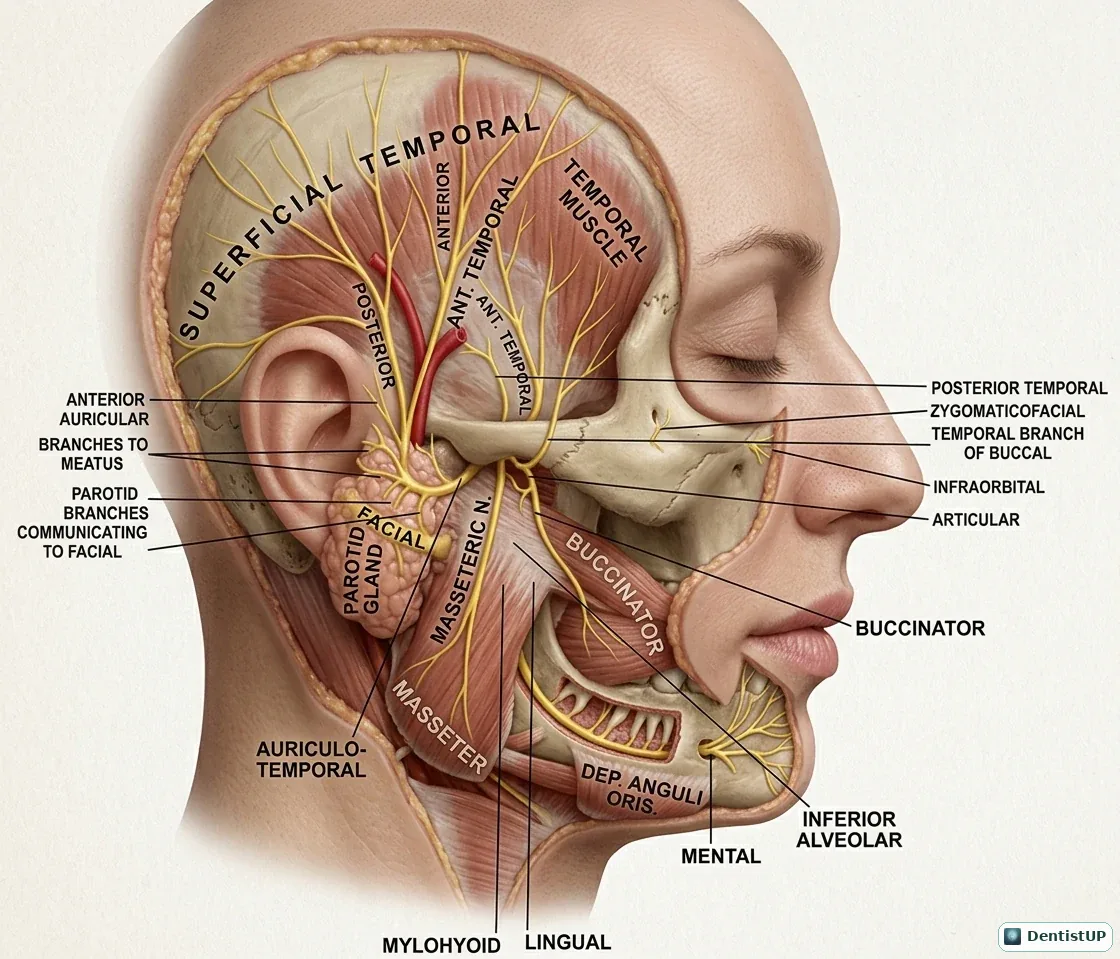
The long buccal nerve block is usually given alongside an IANB to anesthetize which structure?
The answer is D.
The long buccal nerve supplies soft tissue and periosteum on the buccal aspect of the mandibular molars. Because the IANB does not reliably anesthetize this region, a separate long buccal injection is added when buccal soft-tissue anesthesia is needed, such as for extractions.
Question 2 of 10
Management of Medically Complex Patients (Anesthesia Lens)
In a patient with severe Hemophilia A (Factor VIII deficiency), which of the following endodontic procedures is generally preferred over tooth extraction to avoid severe bleeding complications?
The answer is B.
Non-surgical endodontic procedures do not pose a risk of systemic hemorrhage and are highly preferred over surgical extractions in hemophilic patients.
Question 3 of 10
Emergency Preparedness
For an office emergency kit to be effective during a true crisis, which practice matters most for the whole team?
The answer is A.
An emergency kit is only useful if it can be retrieved within seconds during a crisis. Every team member should know its exact location and be able to access it immediately, since the treating clinician is often occupied managing the patient directly.
Question 4 of 10
Local Anesthesia: Complications
A hematoma after a posterior superior alveolar (PSA) injection is most often caused by which event?
The answer is A.
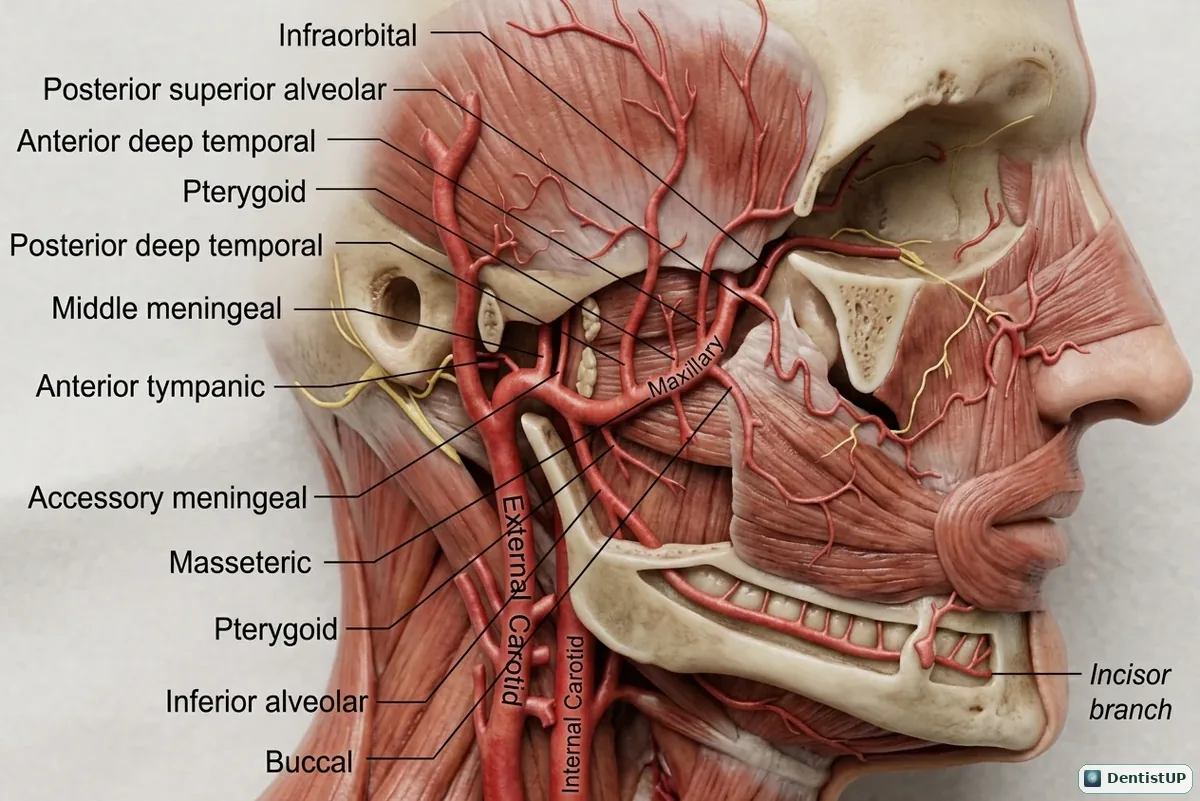
The PSA injection site lies near the pterygoid venous plexus, a dense network of vessels that is easily punctured if the needle is advanced too far or angled incorrectly, leading to rapid blood accumulation in the surrounding soft tissue and visible facial swelling.
Question 5 of 10
Sedation & General Anesthesia
A patient with no systemic disease, normal exercise tolerance, and no medications presents for a routine extraction. Which ASA physical status applies?
The answer is C.
ASA I describes a normal, healthy patient without systemic disease. Since this patient has no medical conditions, normal function, and takes no medications, they meet the criteria for the lowest-risk classification before any sedation or anesthetic is planned.
Question 6 of 10
Local Anesthesia: Pharmacology
Epinephrine is added to local anesthetic solutions mainly because it produces which local effect at the injection site?
The answer is A.
Epinephrine constricts blood vessels at the injection site, slowing vascular uptake of the anesthetic molecule. This prolongs the duration of pulpal and soft-tissue anesthesia, reduces peak plasma anesthetic levels, and improves hemostasis in the surgical field.
Question 7 of 10
Emergency Preparedness
Oral glucose or a sugar source is stocked in the emergency kit mainly to manage which situation?
The answer is D.
A conscious patient showing signs of hypoglycemia can safely take oral glucose or another fast-acting sugar source to quickly raise blood glucose levels. Unconscious patients require a different route, since oral intake risks aspiration.
Question 8 of 10
Local Anesthesia: Injection Technique
A single mandibular molar needs supplemental anesthesia after an IANB left it partly numb, and the operator wants to avoid repeating a full block. Which technique fits best?
The answer is A.
The intraligamentary injection delivers a small volume of anesthetic directly into the periodontal ligament space of the single tooth needing supplemental anesthesia, providing quick, localized pulpal numbness without the need to repeat a full regional nerve block.
Question 9 of 10
Management of Medically Complex Patients (Anesthesia Lens)
A 68-year-old male patient on long-term warfarin therapy (INR 2.5) requires a root canal treatment on a necrotic maxillary central incisor. Which of the following is the most appropriate management regarding his anticoagulant regimen?
The answer is A.
Non-surgical root canal therapy is a non-invasive procedure that does not cause significant bleeding. Therefore, warfarin therapy should not be altered, especially for patients with an INR within the therapeutic range (2.0-3.0).
Question 10 of 10
Local Anesthesia: Injection Technique
A patient needs restorative work on a maxillary first premolar, and infiltration alone gives incomplete anesthesia. Which block most directly targets this tooth's supply?
The answer is B.
The middle superior alveolar nerve, present in roughly two-thirds of patients, supplies the maxillary premolars and the mesiobuccal root of the first molar. Targeting it supplements anesthesia when infiltration alone is insufficient for premolar procedures.
Choose an answer to reveal the explanation.
Related anatomy diagrams
More branches
Full mock exams
DentistUP is an independent educational platform. Socket Science is not affiliated with, endorsed by, sponsored by, or approved by NDEB, INBDE, JCNDE, ADA, GDC, ORE, ADC, or any other examination authority. DentistUP does not contain official or recalled examination questions and does not guarantee examination outcomes. Educational content, not patient-specific clinical advice.