
Vasculature
External Carotid Artery Branches
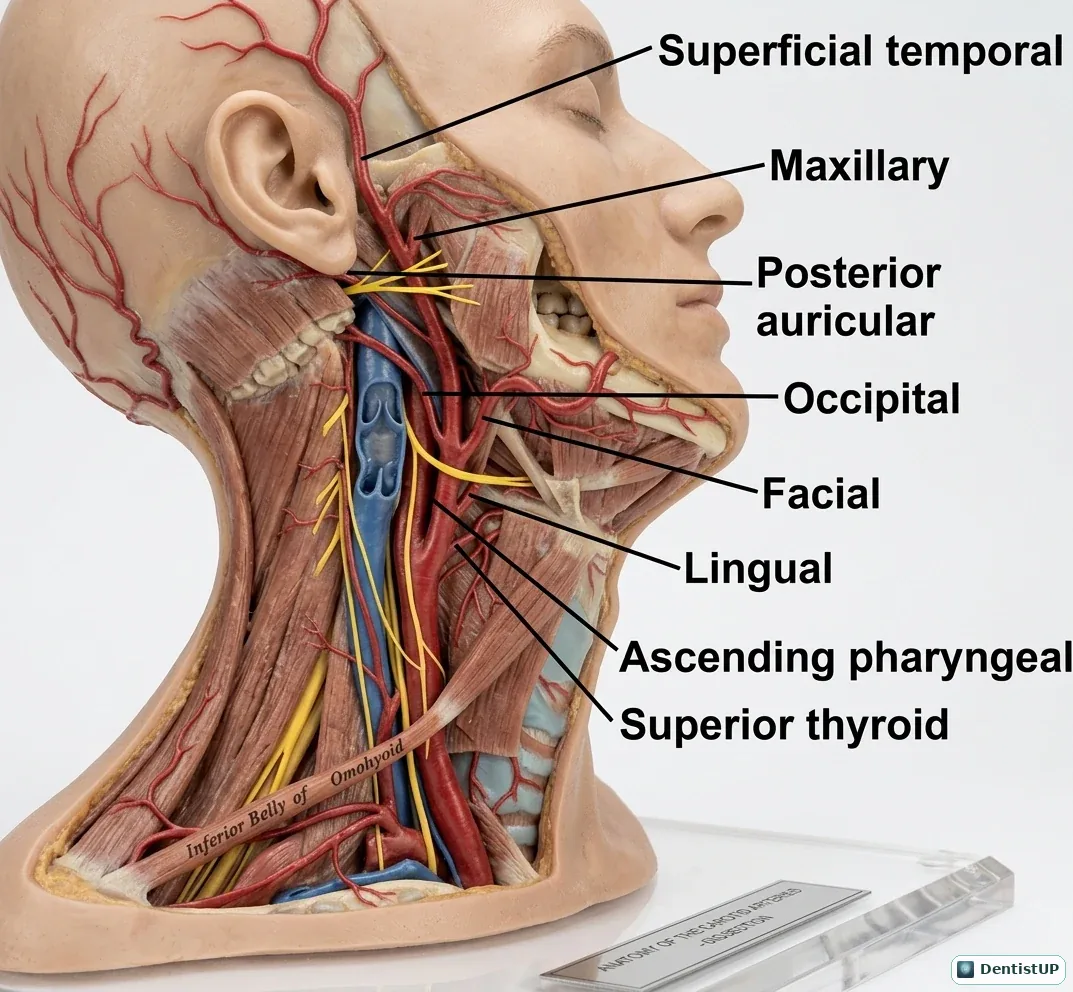
This dissection shows the branches of the external carotid artery in order: superior thyroid, lingual, facial, ascending pharyngeal, occipital, posterior auricular, and the two terminal branches, the maxillary and superficial temporal arteries.
Board exams test both the sequence and the territories. The lingual artery supplies the tongue and floor of the mouth, which matters for bleeding after lingual cortical perforation during implant placement. The facial artery can be palpated at the anterior border of masseter. The maxillary artery, the larger terminal branch, supplies the teeth, jaws and muscles of mastication. Ligation of the external carotid is sometimes discussed for uncontrolled haemorrhage because the internal carotid gives no branches in the neck, which makes the two vessels easy to tell apart surgically.
Related practice questions
Educational illustration for exam preparation, not patient-specific clinical guidance.