
Innervation
Facial Nerve Terminal Branches
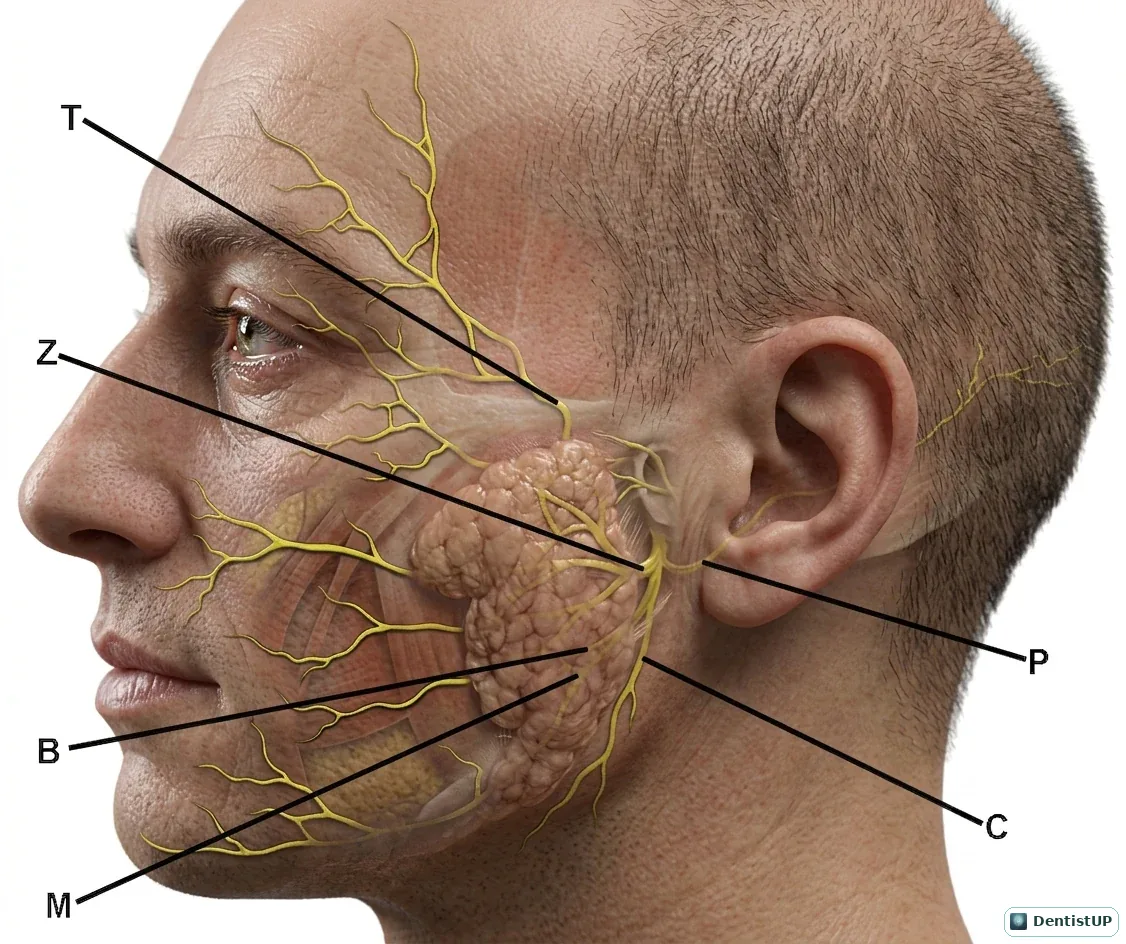
After leaving the stylomastoid foramen, the facial nerve enters the parotid gland and divides into five terminal branches. This illustration marks them as T, Z, B, M and C: temporal, zygomatic, buccal, marginal mandibular and cervical.
These branches supply the muscles of facial expression, so their course explains several clinical and exam scenarios. An inferior alveolar injection placed too far posteriorly can enter the parotid capsule and cause temporary facial palsy on that side. The marginal mandibular branch runs near the lower border of the mandible and is at risk in submandibular incisions. Bell's palsy affects all branches on one side, including the forehead, which helps distinguish it from an upper motor neurone lesion such as a stroke.
Related practice questions
Educational illustration for exam preparation, not patient-specific clinical guidance.