
Innervation
Parasympathetic Ganglia of the Head
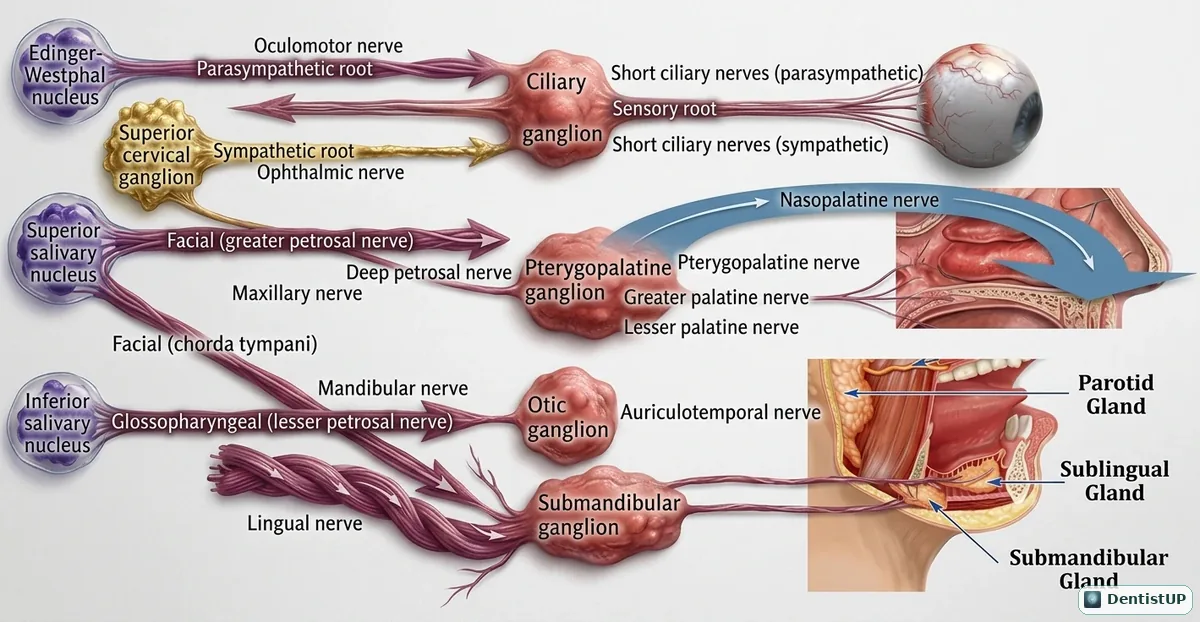
A schematic of the four parasympathetic ganglia of the head. Oculomotor fibres synapse in the ciliary ganglion; facial nerve fibres travel in the greater petrosal nerve to the pterygopalatine ganglion and in the chorda tympani to the submandibular ganglion; glossopharyngeal fibres in the lesser petrosal nerve synapse in the otic ganglion, which supplies the parotid through the auriculotemporal nerve.
This pathway is a reliable source of exam questions because it links several nerves in one chain. Candidates are expected to know which cranial nerve drives secretion from each gland: CN IX for the parotid, CN VII for the submandibular, sublingual, lacrimal and minor glands. It also explains Frey syndrome, in which parotid secretomotor fibres regrow into sweat glands after parotid surgery.
Related practice questions
Educational illustration for exam preparation, not patient-specific clinical guidance.