
TMJ
TMJ Rotation and Translation
License this illustration for your lectures →
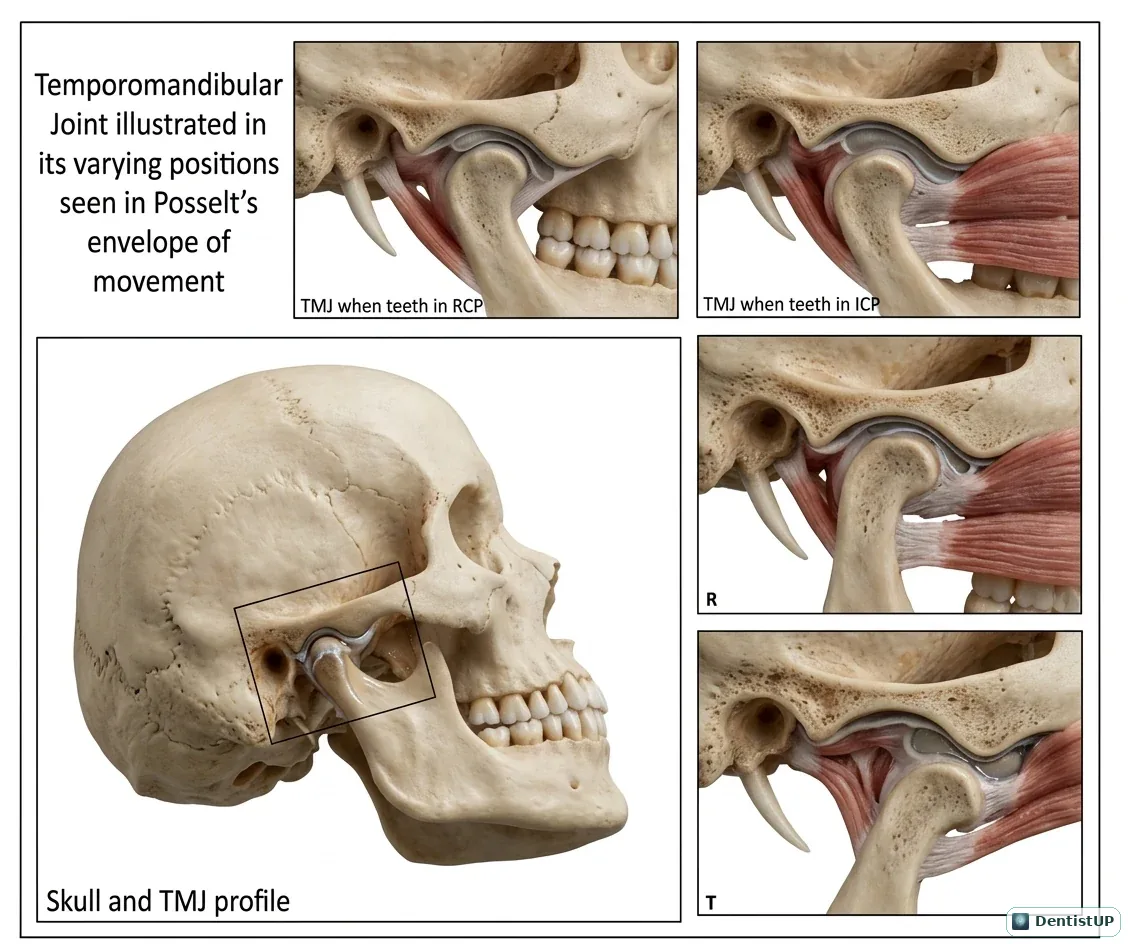
A series of views of the temporomandibular joint in different jaw positions within Posselt's envelope of motion, from teeth together in retruded contact through to wide opening, with a skull profile for orientation.
In the first 20 to 25 mm of opening the condyle mainly rotates in the lower joint compartment. Beyond that, it translates forward with the disc onto the articular eminence, which is how the mouth opens fully. Exams use this to ask about normal opening range, the terminal hinge axis used in prosthodontics, and why limited opening with deviation to one side suggests a problem on that side. Posselt's envelope itself is a common prosthodontics and occlusion recall item.
Test yourself: 5 Orofacial Pain & TMD questions
Free board-style questions with explanations. See all 10 →
Question 1 of 5
TMD Classification
Why is imaging alone insufficient to classify most TMD pain conditions?
The answer is B.
Symptoms, examination, and imaging can be discordant. Classification uses reproducible history and examination rather than pain location alone. Physical diagnosis and psychosocial assessment are complementary: one characterizes the disorder, while the other identifies disability, distress, behavior, and prognostic factors.
Question 2 of 5
Disc Displacement Disorders
Which change may be seen in TMJ degenerative joint disease?
The answer is C.
Degeneration produces a spectrum of destructive and reparative osseous features. Disc and degenerative disorders use symptom history, movement, reproducible sounds, familiar joint pain, and imaging when it changes care. Clicking is not synonymous with pain, loss of a click may reflect loss of reduction, and osseous degeneration may be symptomatic or incidental.
Question 3 of 5
Myofascial Pain & Muscle Disorders
Which measure commonly supports initial management of uncomplicated muscle pain?
The answer is A.
Conservative active care is generally appropriate first. Diagnosis requires familiar pain from a target muscle; referral is documented when pain extends beyond its boundary. Bruxism is a behavior and risk factor, not a universal TMD cause. Splints may protect teeth and modulate load but require monitoring and do not guarantee resolution.
Question 4 of 5
Management Approaches
Why are reversible treatments usually preferred initially for common TMD?
The answer is D.
The uncertain multifactorial course favors low-risk adaptable care first. Care begins with reversible measures matched to diagnosis and monitored by pain and function. Education, exercise, therapy, splints, and medicines have distinct roles. Escalation is reserved for red flags, progression, or persistent major impairment.
Question 5 of 5
Imaging Correlation
Why are both closed- and open-mouth MRI images often obtained?
The answer is B.
The paired positions help determine whether a displaced disc reduces during opening. Imaging answers a question after history and examination. MRI primarily depicts disc, effusion, and soft tissues; CT-based imaging depicts mineralized surfaces. Findings require symptom correlation because structural changes may be incidental or unrelated to the pain source.
Choose an answer to reveal the explanation.
Related practice questions
Educational illustration for exam preparation, not patient-specific clinical guidance.